


Best Mobility Scooter for Elderly Users: A Buyer's Guide
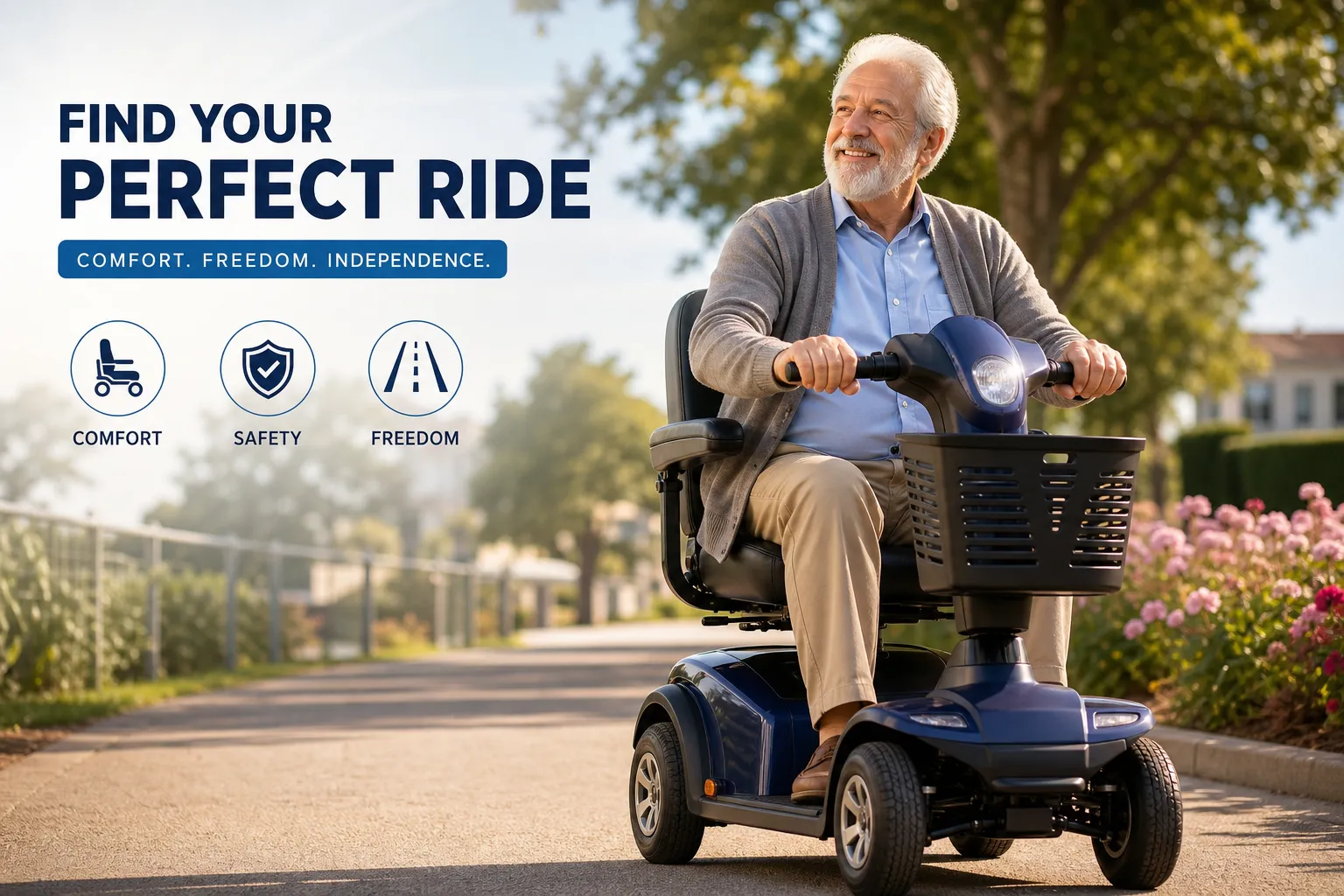
Buyer's guide · 2026
Match the scooter to the rider's daily routine, not the spec sheet.
<55"turning radius for indoor use
+20–30 lbscapacity above rider weight
13–15 mirange for most daily routines
What is the best mobility scooter for an elderly person? Most families think it's a simple buy: find a model that looks right, check the price, order it. Then reality sets in. The scooter can't turn in the hallway, the seat hurts after twenty minutes, or nobody can lift it into the car trunk alone. The good news: once you match the scooter to where and how your loved one actually moves, the right choice becomes clear.
Quick answer
- The best scooter is the one that fits the rider's daily routine and environment, not the one with the most features or the lowest price.
- Indoor or mixed use: choose a turning radius under 55 inches. Compact 3-wheel models typically turn in 35–45 inches.
- Pick a weight capacity 20–30 lbs above the rider's weight. Riders over 250 lbs should go heavy-duty (400–500 lbs capacity).
- Most daily routines need 13–15 miles of range; frequent outdoor riders should look for 20+ miles.
- Top picks at Selected Comfort: GIO Titan for everyday indoor/outdoor use and the FreeRider Luggie line for travel.
At Selected Comfort, we help families choose scooters that fit real senior life, from compact everyday models to heavy-duty outdoor options from trusted brands like GIO Mobility and FreeRider. By the end of this guide, you'll know which type fits your loved one, which features matter most, and which models to seriously consider.
Why so many families end up with the wrong scooter
Most buying mistakes happen when families focus on price and looks instead of the specs that decide daily usability. An outdoor scooter may have a turning radius too wide for a grocery aisle. A lightweight travel model may be uncomfortable for someone who sits in it two to three hours at a stretch. These aren't edge cases. They're among the most common complaints from families who bought from a review roundup instead of a clear picture of real-life use.
Before you compare a single model, answer three questions:
- Where will it be used most? Indoors, outdoors, or a mix of both.
- How far does the rider travel in a typical day? This sets your minimum battery range.
- Does it need to travel? In a car trunk, on a plane, or both.
Those answers narrow the field dramatically and make every other decision faster and more confident.
What is the best mobility scooter for an elderly person? Key features explained
For elderly riders, four specs matter most: seat comfort and height, weight capacity, turning radius and battery range. Controls come a close fifth for anyone with arthritis or a weak grip.
Seat comfort, adjustability and safe transfers
Seat design is rarely the headline spec, but it matters every day. A wide, cushioned seat with a padded backrest, adjustable armrests and a swivel function makes a real difference for someone who gets on and off several times a day.
Adjustable seat height is worth prioritizing too. It affects how easily the rider can plant their feet before standing, which ties directly to transfer safety and fall risk. Look for a seat height range that matches the rider's leg length when seated.
Weight capacity, stability and turning radius
Choose a scooter rated at least 20 to 30 lbs above the rider's actual weight. Running near maximum capacity strains the motor and battery and shortens both. For riders over 250 lbs, a heavy-duty model is a better long-term decision than pushing a mid-range scooter to its limits.
Rule of thumb
Turning radius decides real-world usability. For indoor or mixed use, stay under 55 inches to handle standard hallways and store aisles. Three-wheel compact models typically turn in 35–45 inches; four-wheel indoor models usually fall between 45 and 55 inches. Wider turning radii are fine for outdoor-only riders.
Battery range and ease of operation
For most short-to-moderate routines, 13 to 15 miles of range covers the day comfortably. Frequent outdoor riders or anyone covering longer distances should look for 20 miles or more. Regularly running a battery to empty shortens its life, so a little extra range also extends battery cycle life.
Controls matter more than most buyers expect. A delta tiller, the loop-style handlebar common on senior scooters, may be easier for riders with limited grip strength than a traditional two-lever design. If the rider has arthritis or reduced hand strength, let them test both. This one spec can decide whether the scooter feels manageable or frustrating on day one.
How to choose the best mobility scooter for an elderly person: match the type to the routine
There are three main scooter types. Pick the one that matches where the rider spends most of their time, then compare models within it.
| Scooter type | Best for | Turning radius | Weight capacity | Range to look for |
|---|---|---|---|---|
| Compact / maneuverable | Apartments, stores, medical offices, paved neighborhood routes | Tight: 35–45" (3-wheel), 45–55" (4-wheel) | 20–30 lbs above rider weight | 13–15 miles |
| Lightweight / foldable | Car trunks, trips and air travel | Varies by model | Check per model | 14–22 miles (Luggie line) |
| Heavy-duty / all-terrain | Riders over 250 lbs, uneven or unpaved routes, long daily distances | Wider; less nimble indoors | 400–500 lbs | 20+ miles |
Swipe the table sideways on mobile. Ranges reflect typical category specs as of September 2026; always confirm on the product page.
Compact and maneuverable: best for indoor and neighborhood use
A three-wheel or compact four-wheel design suits apartments, retail stores, medical offices and paved neighborhood routes. Prioritize a tight turning radius, a base that clears standard residential doorways (commonly 32 to 36 inches wide) and enough cushioning for long sits. This is the most common category for seniors who ride mainly at home and on errands, so rank maneuverability above speed and range.
Lightweight and foldable: built for frequent travelers
A travel scooter is defined by two things: how easily it folds or breaks down, and how light it is. For car transport, many buyers aim for the heaviest single piece to weigh under 35 to 40 lbs so a caregiver can lift it without injury.
The FreeRider Luggie line is a strong example. The Luggie Standard folds to 17.5" × 15.5" × 25.5" and weighs 51.7 lbs without the battery, with up to 14 miles of range. The Luggie Elite reaches 15 miles on the standard battery, or 22 miles with the larger 16.5 Ah option.
Flying with a scooter
FAA rules allow lithium-ion batteries up to 300 watt-hours, and the scooter itself is gate-checked, not stored in the cabin. Some airlines are stricter than the FAA baseline, so confirm your carrier's policy before booking.
Heavy-duty and all-terrain: for larger riders or outdoor routes
Heavy-duty scooters serve riders over 250 lbs, anyone riding on uneven or unpaved ground, and people covering long daily distances. Look for 400 to 500 lb capacity, pneumatic or reinforced tires suited to the terrain, and extended range. The wider, more stable base makes them less nimble indoors but much steadier outside.
Top picks at Selected Comfort: recommended models by use case
For everyday senior use, start with the GIO Titan. For travel, start with the FreeRider Luggie line.
| Model | Best for | Turning radius | Max rider weight | Range | Folded size / weight |
|---|---|---|---|---|---|
| GIO Titan | Everyday indoor + outdoor use | 27" | 440 lbs | ~30 miles (typical GIO listing) | Not a folding model |
| GIO Tron PRO | Outdoor-focused, heavier-duty use | 71" | 440 lbs | See product page | Not a folding model |
| FreeRider Luggie Standard | Travel and car storage | See product page | See product page | Up to 14 miles | 17.5" × 15.5" × 25.5"; 51.7 lbs without battery |
| FreeRider Luggie Elite | Travelers who need more range | See product page | See product page | 15 miles (22 with 16.5 Ah battery) | Folding |
Swipe the table sideways on mobile. Specs from manufacturer listings as of September 2026.
GIO Mobility scooters for everyday senior use
GIO Mobility is one of Selected Comfort's featured brands, built around practical daily use for senior riders. Many GIO models list about 30 miles of range, well above most daily needs, so the scooter needs charging less often.
The GIO Titan is our standout pick for indoor or mixed use. Its 27-inch turning radius is one of the tightest in its class, and it supports up to 440 lbs. If your parent runs short errands a few times a week and needs one scooter for inside and outside, the Titan handles both reliably. Riders who want heavy-duty capacity with an outdoor focus can look at the GIO Tron PRO: 440 lbs capacity with a wider 71-inch turning radius suited to open paths.
FreeRider models for travel
FreeRider's Luggie line is the practical choice for riders who need to take a scooter on trips or store it in a car. The folding design is simple and the range is solid for travel. If portability matters most without giving up comfort, the Luggie Elite's extended battery option makes it the more versatile of the two.
Check the lift weight
The Luggie Standard weighs 51.7 lbs without its battery, above the 35–40 lb single-lift target many caregivers aim for. Make sure whoever loads it can manage the weight, or plan for a ramp or car lift.
Safety features caregivers most often overlook
The specs buyers rarely ask about often matter most when something goes wrong. Check these before you commit to any model:
- Braking response and a secure handlebar (tiller) locking mechanism
- Tire type matched to terrain: pneumatic tires absorb uneven ground; solid tires suit smooth indoor floors
- Visibility: lights, reflectors and a horn for pedestrians and low light
- Swivel seat for riders who struggle with transfers
- Tight turning radius for mostly indoor environments
Common causes of scooter accidents include tipping on uneven ground, falls during transfers, collisions in tight spaces and battery or charging problems. Each one has a direct fix in the list above.
Charging safety
Follow the manufacturer's charging and storage instructions exactly. Improper charging is a leading cause of battery failure and, in some cases, a fire risk.
What to budget and what to expect long-term
Most well-built senior scooters cost between $1,000 and $2,200. That's where most everyday and light-travel models sit. Here's how prices break down by category:
Lightweight & travel$600–$1,200
Folding or break-down models built for car trunks and trips.
Mid-range everyday$1,200–$2,500
The sweet spot for comfort, range and indoor/outdoor use.
Heavy-duty & all-terrain$2,500–$5,000+
Higher capacity, rugged tires and longer range for outdoor riders.
Battery replacement is the main long-term cost for daily riders. A pair of sealed lead-acid batteries typically runs $100 to $300; lithium packs range from $300 to over $1,000 depending on the model. Standard scooter batteries average 200 to 300 charge cycles, roughly one to three years depending on use and charging habits. Tires and minor servicing add smaller costs, so set aside a small yearly maintenance budget.
Most manufacturer warranties cover six to twelve months on entry and mid-range models. Battery coverage often ends sooner than the main warranty, and cosmetic wear is usually excluded. Read the terms and ask exactly what the battery coverage includes. See our warranty and financing pages for details.
Before-you-buy checklist
Confirm these before you order
- Main use: indoors, outdoors or mixed
- Typical daily distance, plus a range buffer
- Weight capacity 20–30 lbs above the rider's weight
- Turning radius under 55" for indoor use
- Seat height, swivel and armrests suit safe transfers
- Controls the rider can operate comfortably (delta tiller vs. levers)
- Heaviest piece is liftable if it will travel by car
- Battery and warranty coverage periods in writing
The bottom line
Start with where and how often the scooter will be used. Match that to the right type: compact for indoor and neighborhood use, travel-ready for frequent transport, or heavy-duty for larger riders and outdoor terrain. Then compare seat comfort, turning radius, weight capacity and battery range.
The best mobility scooter for an elderly person is the one that fits their actual daily life, not the one with the most features or the lowest price. A well-matched scooter gives real independence. A poorly matched one sits unused after the first week.
Not sure which scooter fits your loved one?
Tell us how they get around, and our mobility team will help you narrow it down to the right model.
Frequently asked questions
What is the best mobility scooter for an elderly person?
The one that fits their daily routine and environment. For indoor and mixed use, choose a compact model with a turning radius under 55 inches, such as the GIO Titan. For travel, choose a folding model like the FreeRider Luggie. Riders over 250 lbs should choose a heavy-duty scooter.
Is a 3-wheel or 4-wheel scooter better for seniors?
Three-wheel scooters turn tighter (typically 35–45 inches), which helps indoors and in stores. Four-wheel models are generally more stable on outdoor terrain and usually turn in 45–55 inches. Choose based on where the rider spends most of their time.
How much weight capacity does a mobility scooter need?
Pick a scooter rated at least 20 to 30 lbs above the rider's weight. Running near maximum capacity strains the motor and battery. For riders over 250 lbs, a heavy-duty scooter with 400–500 lb capacity is the better long-term choice.
How far can a mobility scooter go on one charge?
Most daily routines need 13 to 15 miles of range. Frequent outdoor riders should look for 20 miles or more. Many GIO Mobility models list about 30 miles, and the FreeRider Luggie Elite reaches up to 22 miles with its larger battery.
How much does a good mobility scooter for seniors cost?
Most well-built senior scooters cost $1,000 to $2,200. Travel models run about $600–$1,200, mid-range everyday models $1,200–$2,500 and heavy-duty models $2,500–$5,000 or more. Budget for battery replacement every one to three years.
Can you take a mobility scooter on a plane?
Yes. FAA rules allow lithium-ion batteries up to 300 watt-hours, and the scooter is gate-checked rather than kept in the cabin. Airline policies vary, so confirm with your carrier before booking. Folding models like the FreeRider Luggie are built for travel.
Sources
- FAA PackSafe: Wheelchairs and mobility devices
- TSA: Battery-powered wheelchairs and mobility devices
- Manufacturer product listings: GIO Mobility and FreeRider (via Selected Comfort), accessed September 2026